Showing posts with label nature. Show all posts

Saturday, 2 March 2013

Spring: Extreme edition

2nd of March...that means spring, right? Well, this year, Trondheim has apparently decided to give us the extreme edition. Other places, you can feel the spring coming on because the sun is shining and it is actually warming you up. And you smell the fragrance of spring. Not so in Trondheim. Here, you can feel spring coming because the wind blows like crazy.

The view out of my window.
Notice the bending trees and the very wet window pane.
And this weekend, we are apparently being treated to the extreme edition of spring, with sleet and a gale. Have I mentioned that I don't really like the in-between seasons - autumn and spring? I don't like the slush, the sleet, the rain, temperatures around zero degrees centigrade, and I especially don't like the the unpredictable weather. I mean, it does help that green things start sprouting and that things go from grey to colour. But that is later - like around May. Sometimes I wish that we could just skip autumn and spring, and just go directly from summer to winter and the other way. But I guess nature needs the time to get used to a new season.


Anyway, I am glad that I have a warm, dry house to be in with a possibility of making tea and watching a film or reading a good book (I Capture the Castle, for example) while the storm rages outside. I will try to remember that I am thankful that I am not outside, and look out at the weather with a satisfaction of knowing that this takes us at least one step closer to summer.

Saturday, 8 December 2012

Cold and dark, with squeaky snow

This is Trondheim these days. There are mountains to the southeast and southwest, so even though the forecast says that the sun came up at 09:45 and went down at 14:36, the actual day is shorter. The sun actually never touches the house I live in, I think. So it is dark as night at about 4, making for looong evenings and disturbed sleep patterns. I try to see the sun every day (when it is a clear day), to be able to feel that it was actually day at one point.

Mentioning weather, it has mostly been clear the last week or so, giving temperatures below -10 degrees Celsius. There are lots of people around in their down jackets and with scarves wound around their head so that only the eyes peek out. Have you ever tried hugging someone who is wearing a down jacket? It's so soft - makes for great hugs. The only sad thing is that my cloak, which is my usual winter outerwear, is being repaired, and it is a bit too cold to use it.

But the skies have not been completely clear, we have had some new snow. It came when it was below -5 degrees Celsius, which gives snow with a wonderful sound. Oh, you thought snow was silent? Not exactly. When it is really cold, the snow sort of squeaks and crunches underfoot. I really like the sound cold snow makes underfoot - I know it is really winter when I hear that sound.

I have found out that I prefer steady seasons - summer and winter. I don't really like the changing seasons, spring and fall, because of all the chilly rain and uncertain weather. Sure, the winter is cold, but it is also beautiful, and you know what you wake up to day after day. Winter is actually the season, from my memory at least, when we have the most stable weather. We can often have really cold periods that last for up to two months (and even more!). That happens when a high pressure field moves down from Siberia and settles over parts of Norway. The sky is clear every day, the sky is starry every night, and the air is crisp and cold.

Still, I prefer sitting inside with a good book and a cup of tea looking out at all this, because the cold air really stings my face, and I often start freezing on my fingers and toes when I am outside for too long. Looking out at the moon shining down and the stars and planets shining down, I look forward to being finished with exams and starting my Christmas holiday.

Oh, and by the way, change is still scary. I moved out of my old big locker and into two small new ones, and  it's really weird. Now I have to go a different place every morning and afternoon - I have sort of changed my home base at school. I had my old locker for one and a half years, and I feel kind of sad leaving it. I think about the weirdest things sometimes. Pull yourself together, Julie! It's only a locker!

I think the exam period is starting to drive me just a tiny bit crazy - I'm starting to talk to myself now... I'll just procrastinate a bit more, to see if I can drive it any further (I am still trying to read 50 books this year, but I have 13 to go...).

Okay, I will stop my ramblings now. Have a great advent, and good luck if you are taking exams or the like!

Sunday, 18 November 2012

Changing skies - November musings

The sky before I wrote this post
The sky is always changing. The clouds appear and disappear, move and make patterns. The sun moves across the sky (or rather, the Earth turns so that the sun appears to be moving) giving different hues to the things on the ground and the clouds. The clouds can be glowing bright yellow, pink or orange. Or they can be soft grays and blues. They can look menacing, soft, heavy, or happy.

And the night sky is a whole other story. The moon can shine out through a veil of clouds, or be obscured or behind the horison. It could also be there one moment, and then be completely covered the next. On starry nights, one can feel so small and so significant at the same time. I feel that when I look up at the stars, I am alone in having that experience. It makes me feel special, in a way. Sometimes I feel that I can reach out and touch the stars, but other times I feel the force keeping me tethered to the Earth, and I feel small and far away.

The sky and the Earth are always changing. But I often feel stuck in the same routines. I feel that each day is just a repeat of the last one, and that next week will just be another week. But the future is undecided, it's just that I can't live with that idea. I seek stability and predictability - it is comforting to know what is going to happen.

The sky when I had written this post
But even the skies and the Earth are governed by natural laws that dictate how and when things change. I wish the laws of my life were easy to follow and understand. Then my life would roll on as easily as the rain comes in from the ocean, and I would always be where I was supposed to be.

Clouds, stars, visible breaths in the cold air, sunsets and fallen leaves are things that add to the atmosphere of November. Darkness is taking over, the days grow shorter. Woolly jumpers are comforting, and a blanket is the perfect thing in the evenings. I sometimes wish I had a fireplace with a comfortable chair where I could sit wrapped in a blanket and read with a cup of redbush tea. This is the perfect season for that.

Musing as the November day turns towards the November night. This was just a piece of the wandering of my thoughts, I hope you enjoyed it.

Monday, 29 October 2012

Watching the world turn

Turning, turning, turning through the years.
Minutes into hours and the hours into years.
Nothing changes. Nothing ever can.
Round about the roundabout and back where you began.
Round and round and back where you began.

From the song "Turning" from Les Misérables, the musical

A sunset (or Earth-turning)
seen from St. Vincent
There is something special about watching the Earth turn. It can be beautiful, mesmerizing, peaceful and awe-inspiring all at the same time. Sunrise is an almost magical time. The first rays of the sun hitting the land, watching the sunshine chase the night away, it's peaceful and pulse-quickening at the same time. Sunset is equally fulfilling to watch, colourful and amazing, but softly fading into night. Here are some more sunsets from the Caribbean. It feels so big but at the same time so ordinary being in those moments when I have the time set aside to watch the sunrise or the sunset. It's like the thoughts I have are coloured by the colours in the sky - stress becomes nothing, and all thoughts mellow out. Now that winter is coming and the days are shorter, I can more often see the sunrise and sunset - if I just remember to look out of the window. Maybe I should make that a priority, to enjoy some tranquil moments during my otherwise slightly stressful days.

The progress of the sun across the sky is something I rarely observe except during the summer, so watching the sun move sluggishly across the sky is something that reminds me of hot summer days with nothing to do but to relax with a good book. Carefree and relaxing days, just watching the world turing and going for the ride.

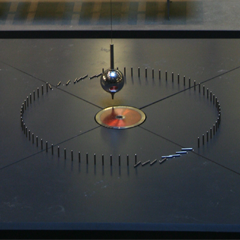
Focault's pendulum
At university, I find myself drawn to another thing that marks the passage of time and the turning of the Earth - Focault's pendulum. The basic idea is that the pendulum moves in the same direction all the time, but because of the rotation of the Earth, its direction appears to be changing. The one here has metal pins set up around it, and these are knocked down about every 8 to 10 minutes (yes, I have timed it).

It is mesmerizing watching it rotate, knowing that when the next pin is knocked down, the world will have changed. Ever so slightly, but changed nonetheless. The Earth turns and we go with it, however unwilling we are to go at that pace. We are turning around and around, but never back again, even though it an feel that way. We are all time-travellers, travelling forwards in time at a speed of one second per second. Those second become hours and days, which become months and years.

Sometimes, watching the Earth spin, I feel so small, stuck down here on this pale blue dot. But then I think of how beautiful this blue ball is, with its teeming life and small everyday miracles like snowflakes and dew drops. It is humbling and awe-inspiring as well as peaceful to witness the turning of the Earth and the passage of time. Happy time travelling, remember to enjoy watching the world turn.

Monday, 3 September 2012

A new family of animals

This is a relatively diverse family, with big differences in colour and size. The genera can be separated by close observation, but this is not usually convenient  to manage. The species can only be identified by experts and connoisseurs. The animals in this family are highly structured in their habits, and these differ throughout the year. The juvenile animals go into hibernation during the winter, while the adult ones simply change habits.

These animals change morphologically throughout the year, with different anterior and/or posterior protrusions marking the different stages. The stages differ from species to species and according to environmental factors. An animal can sometimes revert to a previous stage during a season.

The mating protrusion varies between species, but during the laying of the eggs, the animal devours all available food in its territory. This is necessary to make many large eggs, which are lain uniformly distributed on the whole of the animal's territory at the end of july and the beginning of august in places with clearly defined seasons, but this can vary according to geographical position. After a while, the animal gathers the eggs, which can vary in colour - some observed colours are green, grey, white, and black - in highly structured collections. The eggs are short cylindrical, and are lain on their side. They are not incubated, and hatch evenly throughout the winter, seldom any two at the same time from the same batch. The young animal is small, and therefore goes into hibernation until it is sexually mature, which takes about five years. Relatively few animals survive their first and second winter, usually due to hunger or neglect.

These animals are hermaphroditic, and most of them, when it is too far from the closest individual of the same species, uses self-fertilisation. The complications of this are insignificant for the animal's health. The adult's winter morphology includes an anterior mouth part which is used to eat or move snow, which is its main food during the winter. Some species can have a posterior protrusion for the dispersal of excrement or for camouflaging its trails.

These animals have in recent times been bred to need regular interaction with humans, which is why wild specimens of this family are rare. They are kept as domestic animals. It is unusual that one family owns more than three, as they can be demanding and need large territories with a lot of available food. They are herbivores during the egg-laying, but at other times they can eat humus (especially in the spring and autumn) or snow (during the winter season). Some examples of genera are John Deere and Kubota.


As you can understand, I have been brainwashed this summer...

Saturday, 7 July 2012

So many names!

It started off with floristics, also known as botany (or just plants). I learnt that loads of plants belonged to the rose family, and I learnt a LOT of names of plants and flowers. I would work approximately from nine in the morning till half past eleven in the evening, but of course with breaks during the day. It's a lot to learn in a short amount of time, so I spent a lot of time testing myself and memorizing names.

After four bad days for the people with pollen allergy, we moved on to marine life, and therefore on to faunistics, zoology, or animals, whatever you want to call it. The first day, I studied plankton through a stereo loupe - it was very interesting to see the animals that live floating around haphazardly in the seawater. They have really interesting shapes, and are really tiny. The I moved on to naming the species of live material fished (or scraped) up by the students who were on the research boat that day. I saw, among loads of other things, red sea cucumbers, hermit crabs, and loads of worms.

Look closely at the pilot whale to the left,
and you can see her grey calf beside her 
The next day it was my turn to go aboard the boat. We were really lucky to see loads of pilot whales (they said there were at least a hundred). They were beautiful and cute - and quite large. They had followed schools of fish into the fjord, and according to the people on the ship, they would stay there the whole summer, feeding on fish and having a good time. I saw large males, females and mothers with calves. It was wonderful to see them swimming so close to the boat.

After another day with naming species and then a trip to the beach at low tide, we moved on to terrestrial animals. In other words, insects (and, of course, many other things that live on land). Loads and loads of flies, and one of my favourite groups, the weevils, or snout beetles. We took walks to capture animals in nets (like butterfly nets). Again, there were a lot of names to learn.

Everyone talked about a steep learning curve, and it really was. It was fun, but tiring, with loads of late nights with early mornings following them. Now I can name loads more of the living things I see around me in nature. Going for walks with me will be impossible, since I will most likely stop all the time to study some living thing (and hopefully name it correctly).

Sunday, 10 June 2012

Hairy and dangerous

Hairy petals
There are so many hairy plants! Using my loupe, I have discovered that parts of plants that I never thought had hairs are covered in them. Petals and stamens, for example. And the roughness of grass leaves are due to tiny hairs. And I thought only mammals were hairy!

I mean, of course the hairs are different, but they look very much the same - like hair. Some plants look woolly, and some have silky hair, and some have hairs that hurt you or give the plant a rough feel. The plant kingdom is so very diverse, with lots of interesting ways to survive and thrive.

Hairy moss (putehårstjerne, Syntrichia ruralis)
I am learning about the Norwegian flora and fauna (the plants and animals of Norway), and the main part of my course is to classify organisms. This can be tedious work, but as mentioned before, it can be really fun to know what things are called and what sets them apart from the "crowd". This makes nature even more beautiful and interesting to me, and even short walks can take a very long time.

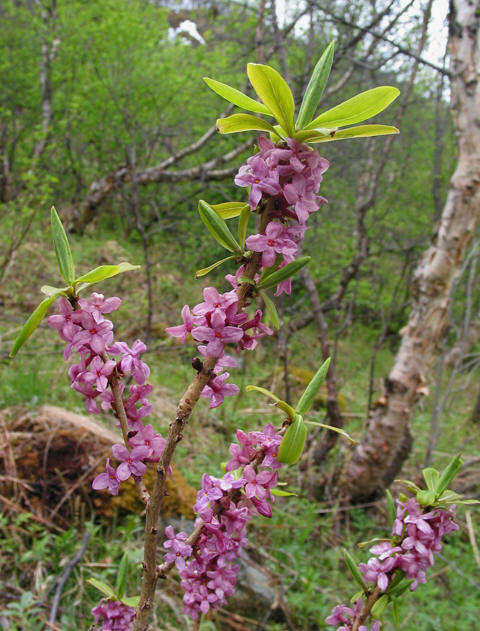
Beware! This lovely plant is really poisonous!
 (tysbast, Daphne mezereum)


I thought  the Norwegian flora was quite boring, but it turns out that there are some relatively aggressive plants. We have flesh-eating plants (soldogg/sundew, Drosera spp.), really poisonous plants (tysbast/mezereon, Daphne mezereum), and stinging plants (brennesle/nesle, Urtica spp.). In addition, almost everything looks better or more interesting through a loupe or a microscope, so there is often something good to discover.

Monday, 26 March 2012

Naming nature

I am beginning to feel the effects of the flora and fauna course I am taking. I can't look at a patch of moss without wondering which moss it is, and I want to know the names of all the birds I see. As spring is coming on and nature wakes up, I become more and more interested in it.

Common Goldeneye pair
The last couple of weeks, as I have looked out of my window while eating breakfast, I have seen some black and white ducks on the river. They would dive suddenly and come up again like a floatation device.  It was nice to have the company on the dreary mornings, but I wanted more. I wanted to label them. Today, I walked home from University and saw them closer up. I found out what they were, finally: Common Goldeneye - or in Norwegian, Kvinand.

Somehow, knowing this doesn't destroy the joy and magic of nature. I will still love having them for company in the mornings, maybe even more, because now that I have a name for them, they'll almost be like friends.

Learning these things about nature - not only the names of things, but also the internal and external structure of plants and animals, their life cycles, their preferred food and their habitat - makes me appreciate nature that I see all around me all the more. Now that I know a little bit of how amazing it is, I can be awestruck every time I see a patch of moss or a little sparrow. I think that is wonderful. I am looking very much forward to the spring coming for real and seeing nature alive and vibrant again.

Wednesday, 15 February 2012

Snowy fields and blood

Microscopy is really interesting, and I'm getting to do quite a lot of it these days. Everyone who have bought a nice camera (SLR or similar) can attest to the fact that macro photography is fascinating. Taking up close pictures of everyday things like food and writing utensils becomes really interesting. Just imagine what happens when you start looking at things through microscopes!

Sometimes I find it hard to believe that what I am seeing through the microscope is what is actually there. Especially cells and organelles (the small thingies (very scientific name) inside cells), which to me have mostly been like atoms and molecules - you know they're there, but you can't see them. But now, suddenly, I can - thanks to these magnifying wonders.

Today, I looked at food mold (the white and green fluffy stuff you find on food that has gone bad) through a microscope at a relatively low magnification. It was really pretty! I wish I had taken a picture of it so I could show you. It looked like hills covered in fluffy snow catching the morning sun. Really beautiful and almost magical. And then you look at it without the microscope, and the immediate reaction is yuck! It really is like two different worlds.

Red blood cells I saw in the lab.
The oval is a red blood cell on its side.
I have recently looked at blood through a microscope too, and that was also pretty awesome. I didn't know that we had that many red blood cells in our blood compared to the number of white blood cells! And I kind of didn't think that they would actually have the form that we associate with red blood cells - but they do! Little discs with a dent in the middle of each side - quite neat, if you ask me.

In short, nature is amazing and awesome in all scales - from the global to the microscopic. And it is elegant and wonderful and really interesting.

Saturday, 29 October 2011

Homesick

So I'll lose some sales
and my boss won't be happy,
but there's only one thing on my mind.
Searching boxes underneath the counter
on a chance that on a tape I'd find

a song for
someone who needs somewhere
to long for.

Homesick
cause I no longer know
where home is.
from "Homesick" by Kings of Convenience

Nowadays I often wonder what it is that makes a place a home. Is it the memories? The people? The books in the bookshelves? The pictures on the walls? The walls who have heard and seen so much? Or maybe the cheesy one - home is where the heart is?

My childhood home has recently been sold, my grandparents' house will soon be sold and pulled down, and I have moved away. Sometimes, when I think about it, I feel that I don't have a physical anchor in the world. Like a place which I can come back to and which doesn't change too much. But, I guess, that is too much to ask of life. I am a control freak. I don't particularly like change, to put it that way. I usually stick to activities, people and places. But life is always in motion, and change is natural. I'm not saying that the change itself is necessarily natural, but the fact that things change is thoroughly natural.

Geranium bohemicum
Literally grows from tragedy
Today, in the biology lecture, we learnt about succession in nature. The directional change of an area's environment, for example a forest growing back after a fire. Change happens in a certain direction until it reaches a final or equilibrium state. But even then, it fluctuates. So change is extremely normal everywhere. Even disturbances such as flooding or forest fire are normal. If the equivalent happened in our lives, we would say it was a disaster or a catastrophe or tragic, but some organisms rely on these disasters to survive. Maybe I and many others could learn from this. We could choose to focus on the good things that spring from the hard times and tragedies, like the beautiful geranium 'Orchid Blue', which has seeds that only flower after a forest fire (or high temperatures). It literally grows from disaster. So instead of being sad about the recent fire, we can marvel at the beauty that sprouts after tragedy has struck.

Change is inevitable and natural. And as someone once said - it's not about how you are, but about how you take it (it sounds better in Norwegian...I'm not that good at translating). And in a way, all our lives are built around change and changes. We grow up, we become older, we experience new things, we change in response to other people, and other people change in response to us. We live in a dynamic world, but still some of us (for example me) manage to get stuck in a fantasy that stability is the most natural thing and change is something strange and something to be feared. I think a good idea is to meet the change and be proactive when approaching it, instead of hiding in the shadows and wishing it would go away. And oh, how I wish I would follow my own advice.

Books read: 45
Pages read: 13110

Thursday, 29 September 2011

Weird nature

I am studying biology, and I am just finished with a module about ethology, which is the study of animal behaviour. Within this topic there are several topics, but one of the weirder ones are the ones about social and sexual relations when it comes to mating. Even though monogamy is the rule (at least traditionally, in the western world) among humans, that is definitely not the case among animals (I am going to draw a line of distinction here, because that is comfortable to me. I know that humans are a type of animal, but I decide here). In this topic, I have been introduced to not only monogamy, but polygyny, polyandry, and even polygynandry.

These are different social and sexual structures within populations of animals (and often humans as well). We are all acquainted with monogamy, or rather, as in today's society, serial monogamy. This is quite uncommon among animals, but some birds have this kind of relationship, and one of the reasons is that the care of their young takes a team effort. But then we have the other types of social and sexual relationship styles.

The most familiar of these is polygyny, or polygamy, which it is often called in humans. This is where one male has several female partners. This is quite normal, and in the species who have this, the females are often (but not always) left alone with the care of their young. The opposite arrangement also exists, where one female has several male partners. This is not very common, but in species with reversed gender roles, this can be quite common.

But the REALLY messed up thing in nature is polygynandry. Both females and males have multiple partners, but it's not a 'group sex' type of thing. In the example we studied, there were sophisticated social structures around this. One female had one to three male partners, and each of the males had one to three females total. Then there was the business of rank within the three males who had the one female, and to me, it just looked really complex.

So yeah, nature has a lot of weird things going on. And I haven't even touched upon the matter of homosexuality or strange ways of reproducing or weird courting systems and performances. But I will say one thing: birds are so much more diverse and interesting than I thought (most of the examples we had were from birds). But just remember that among humans, you find societies with monogamy, polygamy, and polyandry, so it's not just really weird (even though polygynandry is not the norm in any societies of humans that I know of, so to me, it is really weird).

I am sorry if this was a bit long, but I am trying to make up for the fact that I haven't written in a while (not really, it just became long). Here is a funny song about animal sex to make up for it.

Books read: 44
Pages read: 12507

Thursday, 1 September 2011

Hush

The image of you that will live on in me
will not be complete.
The sad memories will shrink
into nothing and disappear,
but the happy memories will expand
and become happier,
bathed in a golden glow.

You will always be happy and healthy.
Nothing can mar your delight
in the warmth of the sun
or the smell of the mountain
on that perfect summer's day.

The laughter and smiles,
the happy times,
the wonderful hikes,
the things that you taught me
about the value of nature and life
will live on in my mind
and shape me as I go on.

So hush;
lay yourself to rest.
We both know
all the words
that should not be said.
But you have made my life
more perfect.


Credit goes to Terry Pratchett, for this wonderful quote. (Otherwise, this is written by me.)

Books read: 42

Monday, 18 July 2011

Gardens and waterfalls

This is going to be the last post about my time in St. Vincent. I know it is overdue, but at least now it is here. The last couple of weeks in the Caribbean, Kristina and I did some sightseeing, so that I could experience the must-dos of the island.

One day, we went to Kingstown to visit the botanical garden and Montreal garden. It was wonderful. The botanical garden had a wonderful alley, see picture. At the top of the alley, there was a space where you could get married. How amazing would that be? It was very well kept, and it was lovely.

From the botanical garden we took an overpriced taxi to the Montreal garden. It is a privately owned garden, and it was absolutely enchanting. There were wonderful flowers everywhere you looked, and cute walkways to experience it all. Most of it was pretty jungle-like, but some parts were manicured and beautiful in that sense. I absolutely loved it and went wild taking pictures of all the wonders of nature.

My last weekend, I decided to visit some waterfalls in the area where I was staying. I went with some friends to a waterfall called Trinity falls. It was quite a long hike, but we found provisions along the way. There were a lot of ripe fruits growing along our route. We found oranges, grapefruit, and mango, and we also bought a pineapple from a farmer we met along the way. The picture shows me holding the almost invisible (or almost eaten) pineapple. It was a bit smaller than I give the impression of, but it was very nice and juicy.

I find water very interesting. We are dependent upon it to survive - our bodies are mostly made up of water. It also makes for interesting visual experiences, and there is something attractive about water falling down a hill or a cliff. It is almost dreamlike to capture in a photograph, but it is the basis of life on this planet. It is everywhere, but at the same time, it captures our interest and draws us to the places where it behaves unusually (i.e. falls down vertically). Clean water is beautiful, not only when it falls down a sheer drop, but when it comes out of our taps or when it saves a baby from dying.

But there are people who don't have access to clean water. In East Africa, there is a drought right now. And instead of just sitting at home enjoying the fact that we can drink the water that comes out of our taps (and the fact that we have water coming out of taps in our homes), we can do something to help other people to enjoy these privileges. If you want to donate to help in the East Africa crisis, you can go here. If you want to help creating a stable and safe water source for communities in developing countries, go here. This organisation works to help children, and therefore also works on creating clean water sources. Water is vital for our survival, and everyone should have access to it.

The day after I had visited Trinity falls, I visited Dark View falls. This is closer to where I was staying, and a wonderful quiet haven. The falling water seemed dreamlike and magical when captured with a camera. It seemed like a beautiful veil, fit for the princess of the forest, from a forgotten fairy tale.

I have a feeling most of you didn't understand last week's blog post. I made a promise to myself that when I finished my challenge of reading 30 books between Christmas 2010 and Christmas 2011, I would write a very silly story incorporating all the titles of the books I had read. So that was last week's blog post, and you can check it out here. Now that I have completed my challenge, I think it is time to reveal to you all that I have had another reading challenge going for a while. I want to join many other people in trying to read 50 books in 2011. So I will be removing the book I read in 2010 from my list, and I will count books and pages read from January 1, 2011.

Books read: 29
Pages read: 7824

Monday, 4 July 2011

Stars

Stars above and stars below
join together in the glow
of nature speeding on its way,
always towards another day.

The starry dance is slow, slow,
but underneath me stars will grow.
Born into this world
when water is swirled.

The dance of fiery points in air
continues on without a care
for the waltz up there
or the tango here
under waves so clear.

All together they join in time
nature's climb
and decline.

Rolling like waves
    ever changing,
    always the same.

The huge eternal ballet
of nature dancing on its way
through night on to a new day.


Books read: 29
Pages read: 7765

Tuesday, 28 June 2011

The end...but not really

In just a few hours I will be leaving St. Vincent. When I say to people here that I am leaving, I sometimes get the question: "Are you happy?" I am taken a bit off guard by this question. What does that really mean?

Am I happy to be leaving this wonderful place with all its abundant nature? Am I happy to leave the people here, that I have gotten to know quite well over the past three months? Am I happy to leave the horses, who have been some of my best friends here? No, no, and no. Of course not.

But then: Am I happy to be going back to a place where I understand what most people say? Am I happy to be going back home? Am I happy that I will meet my friends and family soon? Yes, of course.

I think what the question really asks is whether I am content with leaving at this time. And after having thought a bit about it, I think I can quite firmly answer yes. This has been a wonderful experience, but now I have had my fill. I miss home, a culture that I know, a language that I understand, my family, and my close friends. Of course I will miss this place, but in my heart there is a feeling of 'rightness' about going home now. The place here, the horses, the nature, and the people I have met here will always have a special place in my heart. I will treasure the memories and return to the blogposts I have written about this adventure often (especially during winter, when the days are short and cold).

But my adventures aren't over. Life is in itself an adventure, and next in my life comes a three week stay in England. I also have some things to write about that I have experienced during the last couple of weeks here, so look forward to some more pictures and magical moments. For now, enjoy this film about my everyday life here (I do the voiceover, hope you like it).

Books read: 27

Saturday, 25 June 2011

A wanna ride a harse

Before I came here, I found out via wikipedia that the language spoken in St. Vincent was English. Then I came here, and I realised that I couldn't understand anything. Here at Richmond Vale Academy, most people speak Spanish. I don't speak Spanish, so I was lost at mealtimes, and any time I was with Spanish-speaking people (all the time, in other words). And the locals here speak what is called 'Broken English'.

We had some groups of local schoolchildren visiting a while back. We were showing them around and teaching them about the animals and the gardens. When they came running towards the horses, they would often shout: "A wanna ride a harse!" We thought that was a bit funny. The way they talk here is really difficult to understand. They speak fast, and slur the words together. There are certain sounds they just don't pronounce, like 'th'. 'The' becomes 'da', and 'birthday' becomes something along the lines of 'bird day'. The slogan for one of the political parties in St. Vincent the previous election was: 'We naah tun back'. This was printed on T-shirts (with this spelling), and I didn't understand what it meant before I said it under my breath to myself. It is really strange (and a bit funny) to read these obvious spelling mistakes, since I notice them easily and get irritated if I am at home or on the internet. Here, though, it is mostly just funny. It is really difficult to learn the local language, so the only thing I can actually say (and understand) is 'me na no' (I don't know).

Now, on to something else. These flies have been flying around and landing random places. They are connected in pairs by their bodies, so I have been calling them double flies. It is like I am almost constantly seeing flies having sex, and also having sex on me (in my hair, on my skirt, etc.). Frankly, it's a bit irritating. But it's also fascinating. Especially how they can survive and navigate (if they do so at all), being connected like that. And also what the point of this connecting thing is (how it works). I guess biology is the right field for me, since I'm asking these questions all the time. I love being curious about nature!


Books read: 26
Pages read: 7213

Tuesday, 21 June 2011

Leadership

Now that my stay here is nearing its end, I have realised that I have learned a lot about what constitutes good leadership.

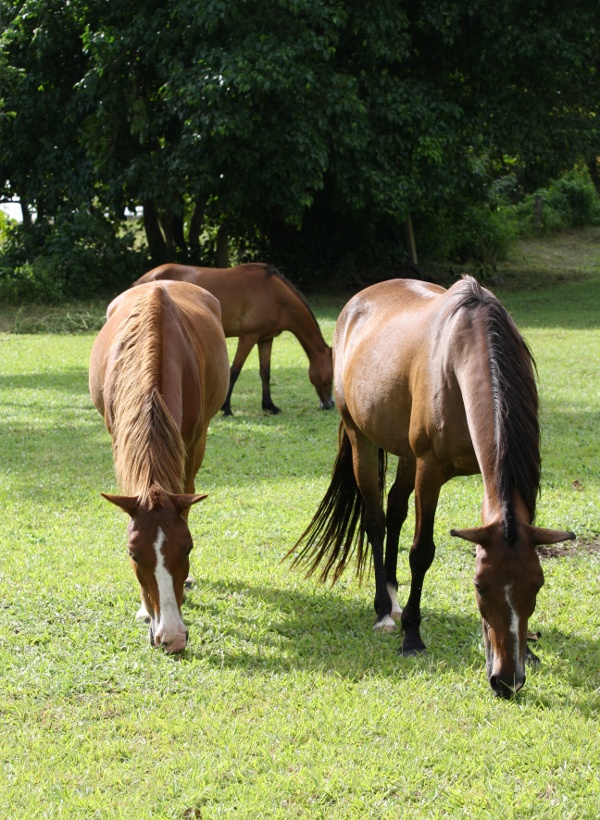
Jack (on the left) and Darling grazing together
In the herd here, there is one mare, Darling, who is the lead mare. In a way, I see her role in the herd as a 'queen'. She is a fair and just leader who leads by example. She is acutely aware of her surroundings at all times and is always the first to investigate something new or scary. She will almost always be the first to notice an open gate, and to notice when my focus is lacking when I'm working with her. She is not dominant, and the others freely choose to follow her. To be elected a leader like that, a horse has to follow the rules of the herd and apply them correctly to increase their rank. In this way, the horse earns respect from the other horses in the herd, and the herd has a say in the forming of the lead horse. Through good leadership and effective pecking order, every horse knows its place in the herd. This creates harmony, security for the individual, and a unified group, working together in the best way according to each horse's ability and personality.

Pecking order is a kind of chain of command, supporting and educating all individuals, from the strongest to the weakest. It is the framework of the herd, and comes from the fact that horses are social  animals, and also prey animals. Because of this they need someone to follow when danger is at hand, so that the whole herd can work together and stay safe. One of the rules in the horses' code (like 'the code' at sea) is that if a horse cannot find a leader to follow, it is its job to lead. (see Naked Liberty by Carolyn Resnick, p.171) A horse feels more secure and safe when it is following a leader, and the best partnerships humans have with horses come from the human proving itself as a good leader to the horse, and the horse deciding to follow and trust the human.

Dictatorship is definitely not good leadership. Dictatorship in a herd would not work at all, and that style of leadership (the dominant style) would always be questioned. The only male in the herd here, Jack, is a dominant horse. He is not as respected as Darling, and is actually number three or four in the pecking order. His leadership is often challenged by the younger horses, and he can get a bit violent with them.

Sadly, though, this is the kind of leadership we often find in leading positions in corporations today. Selfish leadership where rules sometimes are made up along the way, and very few of the workers would choose to follow the boss if given the choice. Leadership is not earned, it is acquired through pushing oneself on and up, often at the expense of others. Good leadership makes people want to follow and please the leader, while dictatorship pushes people away.

I have also realised that the kind of leadership found in lead horses such as Darling, is the kind of leadership you have between dance partners. The man leads, but the intention and goal is that the man and the woman move as one, in harmony. They are partners, but it is clear who is making the decisions. When I dance, I love to really let go and be led. It is such a wonderful feeling. This kind of dancing partnership is therefore possible between humans and horses, and it is really a magical thing.

I am very thankful that I have witnessed such a great example of good leadership here. I will carry this experience with me, and in the process of becoming a better leader myself, I will be on the lookout for good leaders to follow, because in that position I feel more secure and I have the freedom to become creative.

Books read: 26
Pages read: 6963

Tuesday, 14 June 2011

A normal day

Morning action: Cleaning the bathroom and corridor
Shovelling manure into the wheelbarrow...


...and out, onto the compost heap.
Taking Gaia out to eat.


Mmmm....grass...
The donkeys are also taken out to eat on a rope


Time for a snack! This is Dragon fruit, or Pitaya, the fruit from the Moonflower.

Clearing up in the pasture,
these dead palm branches fall down regularly
Checking the fence and cutting bushes to keep them from taking over.

This is fun! Cutting down banana trees
with a huge knife (machete/cutlass)
Giving the horses water (in the green bucket),
making sure that I don't destroy the recently planted corn.


Sharing territory with horses while relaxing in the shade with a good book.
Perfect end of the working day.

Books read: 25
Pages read: 6747

Monday, 6 June 2011

The flipside of the coin

Recently, the horse team (Kristina and I) had an 'open weekend', as it is called here. Really just a mini-holiday or a long weekend. Our open weekend lasted from Saturday the 28th of May till Tuesday the 31st. We decided to go to Union, one of the southernmost of the Grenadines, which are all the islands in this country except the biggest (St. Vincent, where I live). There are around 30 of these smaller islands called Grenadines, and many of them are uninhabited. Not quite your idea of a desert island (with one palm and white sand), but really small nonetheless.

We (A friend from the school named Maria, Kristina, and I) decided to take the slow ferry from Kingstown to Union, which took us approximately four hours. It was nice, and I was pleasantly surprised when it turned out that the ferry was Norwegian! Many of the Norwegian signs had not been removed, and through a little detective work we figured out that the ferry had been in use on the west coast of Norway, maybe in the Bergen area (in the 60's and 70's I would guess). It was very interesting to see signs telling us not to smoke and where to eat in Norwegian. I spent most of the trip lying down reading The Two Towers, because I was exhausted from our two hour long shopping spree in Kingstown (I hate shopping (when it's not for books), and especially when it's hot).

The next day, after a bad night's sleep in a bedroom that was either full of persistent mosquitoes or far too cold with the air condition on, we got a ride to the island 'next door' with one of Maria's many contacts on Union Island. The ride was fun, but a little scary (and quite bumpy), since we were brought across the sea in a tiny inflatable dinghy. On Palm Island, we met another of Maria's contacts, who showed us around on the island. He worked in the hotel that owned most of the island, and also for some of the rich people who owned private holiday houses. I really identified with him, and to me, the houses we walked past seemed like a totally different dominion, and I felt like I didn't belong there. I was peeking in the back window at a world of long baths in private pools, champagne in the morning, massages and golfing. And I really felt that I had no right to enjoy the paradise for free. We had lunch with another worker, who made a wonderful lunch of lobster and lots of other super-delicious things. We discussed politics and talked about the way of the world. Then we enjoyed the white beach and the warm, clear water, before we headed back to Union Island on the worker transport boat.

We then changed into tourists. We ate a good meal at a restaurant belonging to one of the nicer hotels that evening, and the next day we went on a sailing trip with a big catamaran round to some of the other Grenadines. During that trip, we had unlimited drinks and meals included. The first stop on the trip was Palm Island, and now we saw it from the other side. We were tourists who dropped in for half an hour to swim and enjoy the beach. On another island on the trip, we could have bought T-shirts with texts such as 'Sail More - Work Less'. One of the places we went to that day was Tobago Cays Marine Park. There, I got the opportunity of snorkeling with sea turtles. It was wonderful and magical. I saw big ones, smaller ones, and huge ones. One of the big ones had a 'pilot fish' - a fish (a sucker fish) that had connected itself to the turtle's shell. The turtles were grazing on the seaweed that grew on the sandy bottom, and they looked really peaceful.

I enjoyed the trip very much, and it was especially interesting to see the flipside of the commercial coin. To feel like there is a world where you are clearly on a lower rung of the ladder, and that I didn't belong at all, was an interesting experience to me. It was a bit strange to reverse it and to be able to jump up the ladder the next day, but I feel like I have gained a new perspective on tourism through this trip.

Books read: 23
Pages read: 6204

Tuesday, 17 May 2011

Pruning the fence posts

A while back, the banana field next to the horses' pasture was fenced in so that the horses could eat in there. We were told that as a part of our daily tasks, we were to check the fence every day to make sure that nothing grew on it or was otherwise hindering the electricity flow. So we started doing that. After a couple of days, we saw that the fence posts had started sprouting little green leaves. The logical thing to us was to remove them.

But apparently that wasn't the right thing to do. Stina explained that we had to leave at least some of the leaves to grow, or else the post would die. And then it would rot and fall down. It was also very important that the posts were put in the ground the right way up, or else they would not sprout. As I have said before: everything grows here. You can cut down a tree, cut it into 20 pieces, and lay the pieces on the ground, and after a week or two they would start sprouting, and you would have the beginnings of 20 clones of the chopped-down tree.

I have actually seen this happen (although not of that magnitude). The other day I passed the chunks still left from cutting up a big tree in front of the academy, and a couple of them were sprouting new tiny leaves. Big chunks of tree-trunk, sprouting just because they could! Wow. I love how the plant life here is always multiplying and so very alive. At home, in Norway, if a tree was cut down and left lying on the ground, I would be pretty surprised if it started sprouting leaves and making new roots for itself.

So instead of cutting off all the green sprouts on the fence posts, we now just prune them so that they don't interfere with the fence wire. So now, the fence posts look like small trees. Eventually, they might end up like the huge trees I saw once when I went to New Zealand. Really tall (and thick) poplar trees that are over 100 year old, which grew from fence posts in the Buried Village in the Rotorua area. Let's hope they don't, at least not in the foreseeable future. The more likely thing to happen, though, is that the fence posts will grow and bring the fence higher up. Then there would be a constant need to adjust the height of the fence.

I am once again in awe of nature. How marvellous! It's almost like magic: just break a part of the plant off and stick it in the ground the right way up, and you have a new plant! Just like that! If only it was that simple in every climate. But then, fast-growing things make for more things to keep cutting back from taking over. Good things never come without at least one disadvantage. But even so, nature is amazing and really awesome!

Books read: 19
Pages read: 5339