Showing posts with label plants. Show all posts

Saturday, 7 July 2012

So many names!

It started off with floristics, also known as botany (or just plants). I learnt that loads of plants belonged to the rose family, and I learnt a LOT of names of plants and flowers. I would work approximately from nine in the morning till half past eleven in the evening, but of course with breaks during the day. It's a lot to learn in a short amount of time, so I spent a lot of time testing myself and memorizing names.

After four bad days for the people with pollen allergy, we moved on to marine life, and therefore on to faunistics, zoology, or animals, whatever you want to call it. The first day, I studied plankton through a stereo loupe - it was very interesting to see the animals that live floating around haphazardly in the seawater. They have really interesting shapes, and are really tiny. The I moved on to naming the species of live material fished (or scraped) up by the students who were on the research boat that day. I saw, among loads of other things, red sea cucumbers, hermit crabs, and loads of worms.

Look closely at the pilot whale to the left,
and you can see her grey calf beside her 
The next day it was my turn to go aboard the boat. We were really lucky to see loads of pilot whales (they said there were at least a hundred). They were beautiful and cute - and quite large. They had followed schools of fish into the fjord, and according to the people on the ship, they would stay there the whole summer, feeding on fish and having a good time. I saw large males, females and mothers with calves. It was wonderful to see them swimming so close to the boat.

After another day with naming species and then a trip to the beach at low tide, we moved on to terrestrial animals. In other words, insects (and, of course, many other things that live on land). Loads and loads of flies, and one of my favourite groups, the weevils, or snout beetles. We took walks to capture animals in nets (like butterfly nets). Again, there were a lot of names to learn.

Everyone talked about a steep learning curve, and it really was. It was fun, but tiring, with loads of late nights with early mornings following them. Now I can name loads more of the living things I see around me in nature. Going for walks with me will be impossible, since I will most likely stop all the time to study some living thing (and hopefully name it correctly).

Sunday, 10 June 2012

Hairy and dangerous

Hairy petals
There are so many hairy plants! Using my loupe, I have discovered that parts of plants that I never thought had hairs are covered in them. Petals and stamens, for example. And the roughness of grass leaves are due to tiny hairs. And I thought only mammals were hairy!

I mean, of course the hairs are different, but they look very much the same - like hair. Some plants look woolly, and some have silky hair, and some have hairs that hurt you or give the plant a rough feel. The plant kingdom is so very diverse, with lots of interesting ways to survive and thrive.

Hairy moss (putehårstjerne, Syntrichia ruralis)
I am learning about the Norwegian flora and fauna (the plants and animals of Norway), and the main part of my course is to classify organisms. This can be tedious work, but as mentioned before, it can be really fun to know what things are called and what sets them apart from the "crowd". This makes nature even more beautiful and interesting to me, and even short walks can take a very long time.

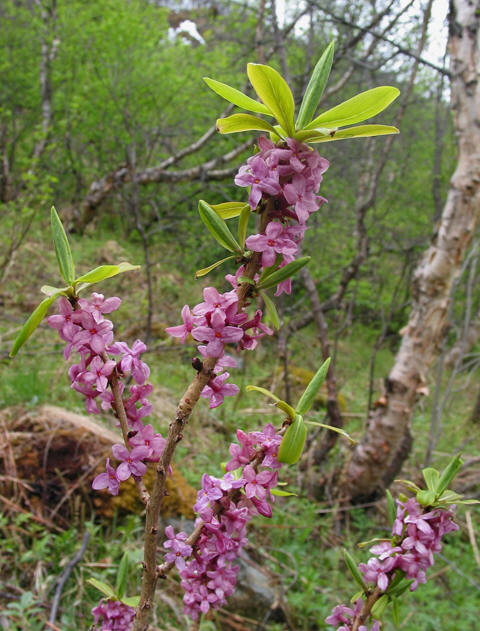
Beware! This lovely plant is really poisonous!
 (tysbast, Daphne mezereum)


I thought  the Norwegian flora was quite boring, but it turns out that there are some relatively aggressive plants. We have flesh-eating plants (soldogg/sundew, Drosera spp.), really poisonous plants (tysbast/mezereon, Daphne mezereum), and stinging plants (brennesle/nesle, Urtica spp.). In addition, almost everything looks better or more interesting through a loupe or a microscope, so there is often something good to discover.