Showing posts with label summer. Show all posts

Monday, 29 October 2012

Watching the world turn

Turning, turning, turning through the years.
Minutes into hours and the hours into years.
Nothing changes. Nothing ever can.
Round about the roundabout and back where you began.
Round and round and back where you began.

From the song "Turning" from Les Misérables, the musical

A sunset (or Earth-turning)
seen from St. Vincent
There is something special about watching the Earth turn. It can be beautiful, mesmerizing, peaceful and awe-inspiring all at the same time. Sunrise is an almost magical time. The first rays of the sun hitting the land, watching the sunshine chase the night away, it's peaceful and pulse-quickening at the same time. Sunset is equally fulfilling to watch, colourful and amazing, but softly fading into night. Here are some more sunsets from the Caribbean. It feels so big but at the same time so ordinary being in those moments when I have the time set aside to watch the sunrise or the sunset. It's like the thoughts I have are coloured by the colours in the sky - stress becomes nothing, and all thoughts mellow out. Now that winter is coming and the days are shorter, I can more often see the sunrise and sunset - if I just remember to look out of the window. Maybe I should make that a priority, to enjoy some tranquil moments during my otherwise slightly stressful days.

The progress of the sun across the sky is something I rarely observe except during the summer, so watching the sun move sluggishly across the sky is something that reminds me of hot summer days with nothing to do but to relax with a good book. Carefree and relaxing days, just watching the world turing and going for the ride.
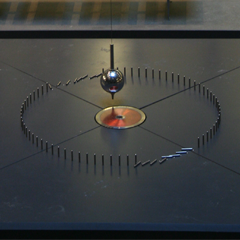
Focault's pendulum
At university, I find myself drawn to another thing that marks the passage of time and the turning of the Earth - Focault's pendulum. The basic idea is that the pendulum moves in the same direction all the time, but because of the rotation of the Earth, its direction appears to be changing. The one here has metal pins set up around it, and these are knocked down about every 8 to 10 minutes (yes, I have timed it).

It is mesmerizing watching it rotate, knowing that when the next pin is knocked down, the world will have changed. Ever so slightly, but changed nonetheless. The Earth turns and we go with it, however unwilling we are to go at that pace. We are turning around and around, but never back again, even though it an feel that way. We are all time-travellers, travelling forwards in time at a speed of one second per second. Those second become hours and days, which become months and years.

Sometimes, watching the Earth spin, I feel so small, stuck down here on this pale blue dot. But then I think of how beautiful this blue ball is, with its teeming life and small everyday miracles like snowflakes and dew drops. It is humbling and awe-inspiring as well as peaceful to witness the turning of the Earth and the passage of time. Happy time travelling, remember to enjoy watching the world turn.

Monday, 3 September 2012

A new family of animals

This is a relatively diverse family, with big differences in colour and size. The genera can be separated by close observation, but this is not usually convenient  to manage. The species can only be identified by experts and connoisseurs. The animals in this family are highly structured in their habits, and these differ throughout the year. The juvenile animals go into hibernation during the winter, while the adult ones simply change habits.

These animals change morphologically throughout the year, with different anterior and/or posterior protrusions marking the different stages. The stages differ from species to species and according to environmental factors. An animal can sometimes revert to a previous stage during a season.

The mating protrusion varies between species, but during the laying of the eggs, the animal devours all available food in its territory. This is necessary to make many large eggs, which are lain uniformly distributed on the whole of the animal's territory at the end of july and the beginning of august in places with clearly defined seasons, but this can vary according to geographical position. After a while, the animal gathers the eggs, which can vary in colour - some observed colours are green, grey, white, and black - in highly structured collections. The eggs are short cylindrical, and are lain on their side. They are not incubated, and hatch evenly throughout the winter, seldom any two at the same time from the same batch. The young animal is small, and therefore goes into hibernation until it is sexually mature, which takes about five years. Relatively few animals survive their first and second winter, usually due to hunger or neglect.

These animals are hermaphroditic, and most of them, when it is too far from the closest individual of the same species, uses self-fertilisation. The complications of this are insignificant for the animal's health. The adult's winter morphology includes an anterior mouth part which is used to eat or move snow, which is its main food during the winter. Some species can have a posterior protrusion for the dispersal of excrement or for camouflaging its trails.

These animals have in recent times been bred to need regular interaction with humans, which is why wild specimens of this family are rare. They are kept as domestic animals. It is unusual that one family owns more than three, as they can be demanding and need large territories with a lot of available food. They are herbivores during the egg-laying, but at other times they can eat humus (especially in the spring and autumn) or snow (during the winter season). Some examples of genera are John Deere and Kubota.


As you can understand, I have been brainwashed this summer...

Saturday, 11 August 2012

Summer haul

The summer holiday is soon over, and any holiday is book buying time (especially when in England, since the books are cheaper there). This time, I think that maybe I bought a bit too many books (the plan was one). But I love buying books! So here they are, the books and DVDs (as well as some old second-hand comic magasines) I have bought this summer.


Wow...that is a lot of stuff (full list below). No more books before Christmas! Except the already preordered ones and schoolbooks, of course... And preferably no more DVDs either, excepting new releases, like the Hunger Games, of course.

And how many of these books have I read? Only three: Dawn of the Bunny Suicides, Fahrenheit 451 (for the nerdfighter book club), and Wonderstruck. I LOVED Wonderstruck, it was fantastic. Just wonderful and beautiful. If you haven't read it yet, read it, and soon (it doesn't take long to read, since half the pages are drawings)!

This summer, I have also been listening to Harry Potter audio books, read by Stephen Fry. He is a very good audio book reader (is that what you call it?), and I am enjoying it. As I have scrolled through the chapters on my iPod, I am starting to appreciate J.K. Rowling's skill in naming chapters. Usually, when I read, I don't really read the chapter title (sorry, writers). So being aware of the chapter title is a new experience. I am also, as I listen to the audio book, picking up little rhymes and alliteration that I don't catch when I'm reading. This adds even more fun to the reading experience for me.

I hope to be blogging more often this autumn (than this summer - it won't take much), but I can't guarantee anything, since I am not going to force myself to write (unless you readers (if you are out there) demand it).


I love lists, so here is a list of all the stuff in the picture:

Book on top:
    Dawn of the Bunny Suicides - Andy Riley
Standing, from left to right:
  DVDs:
    Night at the Museum
    Slumdog Millionaire
    Pixar Short Film Collection volume 1
    Wall-e
    Tangled
    Stardust
    Love actually
    Emma
    Hugo
    Footloose
    Finding Nemo
  Books:
    Miles, Mutants and Microbes - Lois McMaster Bujold
    Masterharper of Pern - Anne McCaffrey
    Acorna - Anne McCaffrey and Margaret Ball
    Acorna's Quest - Anne McCaffrey and Margaret Ball
    Fahrenheit 451 - Ray Bradbury
    Let it Snow - John Green, Maureen Johnson, and Lauren Myracle
    I Capture the Castle - Dodie Smith
    The Eyre Affair - Jasper Fforde
    The Night Circus - Erin Morgenstern
    The Second Book of General Ignorance - John Lloyd and John Mitchinson
    Doctor Who: Dead of Winter - James Goss
    Ohrid - Tor Obrestad (poems)
    Wonderstruck - Brian Selznick
    On Dragonwings - Anne McCaffrey
    Daytripper - Fábio Moon
Lying on the floor:
    One Calvin and Hobbes magasine, and nine old Donald Duck magasines, all in Norwegian. I don't know if there even exists Donald Duck comic magasines outside Scandinavia...you are definitely missing out.

Saturday, 7 July 2012

So many names!

It started off with floristics, also known as botany (or just plants). I learnt that loads of plants belonged to the rose family, and I learnt a LOT of names of plants and flowers. I would work approximately from nine in the morning till half past eleven in the evening, but of course with breaks during the day. It's a lot to learn in a short amount of time, so I spent a lot of time testing myself and memorizing names.

After four bad days for the people with pollen allergy, we moved on to marine life, and therefore on to faunistics, zoology, or animals, whatever you want to call it. The first day, I studied plankton through a stereo loupe - it was very interesting to see the animals that live floating around haphazardly in the seawater. They have really interesting shapes, and are really tiny. The I moved on to naming the species of live material fished (or scraped) up by the students who were on the research boat that day. I saw, among loads of other things, red sea cucumbers, hermit crabs, and loads of worms.

Look closely at the pilot whale to the left,
and you can see her grey calf beside her 
The next day it was my turn to go aboard the boat. We were really lucky to see loads of pilot whales (they said there were at least a hundred). They were beautiful and cute - and quite large. They had followed schools of fish into the fjord, and according to the people on the ship, they would stay there the whole summer, feeding on fish and having a good time. I saw large males, females and mothers with calves. It was wonderful to see them swimming so close to the boat.

After another day with naming species and then a trip to the beach at low tide, we moved on to terrestrial animals. In other words, insects (and, of course, many other things that live on land). Loads and loads of flies, and one of my favourite groups, the weevils, or snout beetles. We took walks to capture animals in nets (like butterfly nets). Again, there were a lot of names to learn.

Everyone talked about a steep learning curve, and it really was. It was fun, but tiring, with loads of late nights with early mornings following them. Now I can name loads more of the living things I see around me in nature. Going for walks with me will be impossible, since I will most likely stop all the time to study some living thing (and hopefully name it correctly).

Sunday, 3 June 2012

Summer reading

And I'm back! After a long break from both reading novels and writing blogposts, also known as exam time, I have come back to talk about what I'm going to read this summer. This summer will be different than usual, field courses and trips to go on, and an exam at the end of the "holiday". Nonetheless, I will be getting back to reading books, catching up with the 50 books challenge (according to goodreads, I'm one book behind), and finishing Les Misérables.

That is actually a major goal with my reading this summer - finishing Les Misérables. I have been reading it since Christmas, and as you can see from the picture, I am almost halfway (the green bookmark marks the page). I actually like it quite a lot, but reading it requires a good portion of concentration and time. I mean, I'm almost halfway, but I still have over eight hundred pages to go! And I will finish it!

In addition I will finish The Wind in the Willows, which I started during the exam period, but didn't finish. It's a pleasant children's book, perfect for getting back into reading. Next on my list is to read Good Omens by Terry Pratchett and Neil Gaiman. This is for a youtube book club that sablecaught is arranging, and I am looking forward to reading and talking about a book with others. Next up after that, is Miss Peregrine's Home for Peculiar Children, which lots of people have recommended. The cover and design of the book are lovely, and I can't wait to know what's inside that beautiful cover.

During the summer, I will also read three Pern books by Anne McCaffrey. I discovered that my local library actually have many Pern books, so I borrowed three of them for summer reading. I love the world of Pern, and I can't wait to visit it again.
And then I have the "just in case"-books. If I finish the previous books, I will read one of the ones in the picture.  Name of the Wind and the two last books of His Dark Materials have been sitting on my shelf for far too long, so they will be priorities. Everyone I talk to who have read Name of the Wind have loved it, and they all assure me that it is a gem, and something to look forward to. I just hope it lives up to the hype. I haven't read The Help yet, or seen the movie (I pledged, remember?). So that will be done soon, if not during the summer. I have also heard good things about Between Shades of Gray, so I'm looking forward to reading that one too.
This is shaping up to be a summer full of the reading of good books and learning to name nature. I'm almost becoming a child again, running around in the woods or along the beach being amazed by nature, shouting out when I find something cool. Many organisms have earned this label lately, spiders among others. I am a bit overwhelmed by the sheer number of animals and plants we have to know, but i think it's fun. It's almost like going treasure hunting, and who doesn't love that?