In just a few hours I will be leaving St. Vincent. When I say to people here that I am leaving, I sometimes get the question: "Are you happy?" I am taken a bit off guard by this question. What does that really mean?
Am I happy to be leaving this wonderful place with all its abundant nature? Am I happy to leave the people here, that I have gotten to know quite well over the past three months? Am I happy to leave the horses, who have been some of my best friends here? No, no, and no. Of course not.
But then: Am I happy to be going back to a place where I understand what most people say? Am I happy to be going back home? Am I happy that I will meet my friends and family soon? Yes, of course.
I think what the question really asks is whether I am content with leaving at this time. And after having thought a bit about it, I think I can quite firmly answer yes. This has been a wonderful experience, but now I have had my fill. I miss home, a culture that I know, a language that I understand, my family, and my close friends. Of course I will miss this place, but in my heart there is a feeling of 'rightness' about going home now. The place here, the horses, the nature, and the people I have met here will always have a special place in my heart. I will treasure the memories and return to the blogposts I have written about this adventure often (especially during winter, when the days are short and cold).
But my adventures aren't over. Life is in itself an adventure, and next in my life comes a three week stay in England. I also have some things to write about that I have experienced during the last couple of weeks here, so look forward to some more pictures and magical moments. For now, enjoy this film about my everyday life here (I do the voiceover, hope you like it).
Books read: 27
Showing posts with label Waterhole Rituals. Show all posts
Showing posts with label Waterhole Rituals. Show all posts
Tuesday, 28 June 2011


Tuesday, 21 June 2011
Leadership
Now that my stay here is nearing its end, I have realised that I have learned a lot about what constitutes good leadership.
In the herd here, there is one mare, Darling, who is the lead mare. In a way, I see her role in the herd as a 'queen'. She is a fair and just leader who leads by example. She is acutely aware of her surroundings at all times and is always the first to investigate something new or scary. She will almost always be the first to notice an open gate, and to notice when my focus is lacking when I'm working with her. She is not dominant, and the others freely choose to follow her. To be elected a leader like that, a horse has to follow the rules of the herd and apply them correctly to increase their rank. In this way, the horse earns respect from the other horses in the herd, and the herd has a say in the forming of the lead horse. Through good leadership and effective pecking order, every horse knows its place in the herd. This creates harmony, security for the individual, and a unified group, working together in the best way according to each horse's ability and personality.
Pecking order is a kind of chain of command, supporting and educating all individuals, from the strongest to the weakest. It is the framework of the herd, and comes from the fact that horses are social animals, and also prey animals. Because of this they need someone to follow when danger is at hand, so that the whole herd can work together and stay safe. One of the rules in the horses' code (like 'the code' at sea) is that if a horse cannot find a leader to follow, it is its job to lead. (see Naked Liberty by Carolyn Resnick, p.171) A horse feels more secure and safe when it is following a leader, and the best partnerships humans have with horses come from the human proving itself as a good leader to the horse, and the horse deciding to follow and trust the human.
Dictatorship is definitely not good leadership. Dictatorship in a herd would not work at all, and that style of leadership (the dominant style) would always be questioned. The only male in the herd here, Jack, is a dominant horse. He is not as respected as Darling, and is actually number three or four in the pecking order. His leadership is often challenged by the younger horses, and he can get a bit violent with them.
Sadly, though, this is the kind of leadership we often find in leading positions in corporations today. Selfish leadership where rules sometimes are made up along the way, and very few of the workers would choose to follow the boss if given the choice. Leadership is not earned, it is acquired through pushing oneself on and up, often at the expense of others. Good leadership makes people want to follow and please the leader, while dictatorship pushes people away.
I have also realised that the kind of leadership found in lead horses such as Darling, is the kind of leadership you have between dance partners. The man leads, but the intention and goal is that the man and the woman move as one, in harmony. They are partners, but it is clear who is making the decisions. When I dance, I love to really let go and be led. It is such a wonderful feeling. This kind of dancing partnership is therefore possible between humans and horses, and it is really a magical thing.
I am very thankful that I have witnessed such a great example of good leadership here. I will carry this experience with me, and in the process of becoming a better leader myself, I will be on the lookout for good leaders to follow, because in that position I feel more secure and I have the freedom to become creative.
Books read: 26
Pages read: 6963
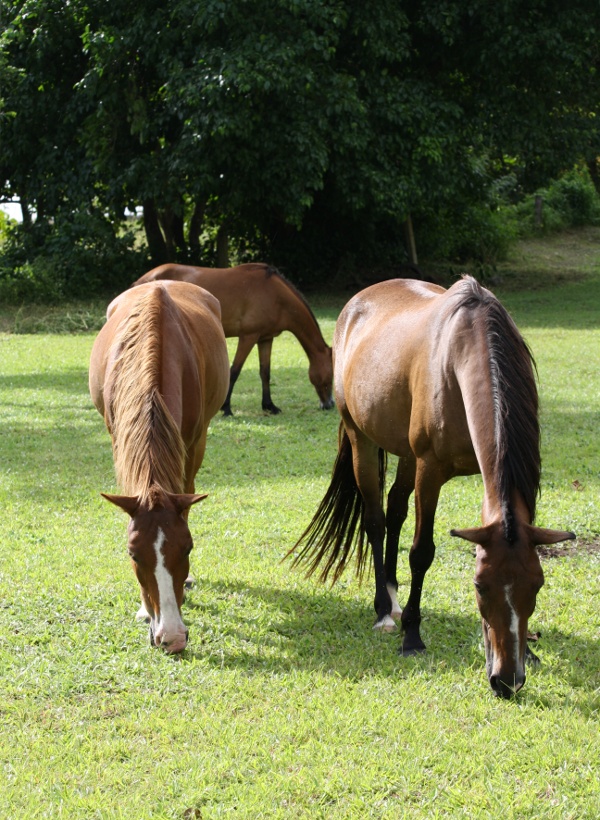 |
| Jack (on the left) and Darling grazing together |
Pecking order is a kind of chain of command, supporting and educating all individuals, from the strongest to the weakest. It is the framework of the herd, and comes from the fact that horses are social animals, and also prey animals. Because of this they need someone to follow when danger is at hand, so that the whole herd can work together and stay safe. One of the rules in the horses' code (like 'the code' at sea) is that if a horse cannot find a leader to follow, it is its job to lead. (see Naked Liberty by Carolyn Resnick, p.171) A horse feels more secure and safe when it is following a leader, and the best partnerships humans have with horses come from the human proving itself as a good leader to the horse, and the horse deciding to follow and trust the human.
Dictatorship is definitely not good leadership. Dictatorship in a herd would not work at all, and that style of leadership (the dominant style) would always be questioned. The only male in the herd here, Jack, is a dominant horse. He is not as respected as Darling, and is actually number three or four in the pecking order. His leadership is often challenged by the younger horses, and he can get a bit violent with them.
Sadly, though, this is the kind of leadership we often find in leading positions in corporations today. Selfish leadership where rules sometimes are made up along the way, and very few of the workers would choose to follow the boss if given the choice. Leadership is not earned, it is acquired through pushing oneself on and up, often at the expense of others. Good leadership makes people want to follow and please the leader, while dictatorship pushes people away.
I have also realised that the kind of leadership found in lead horses such as Darling, is the kind of leadership you have between dance partners. The man leads, but the intention and goal is that the man and the woman move as one, in harmony. They are partners, but it is clear who is making the decisions. When I dance, I love to really let go and be led. It is such a wonderful feeling. This kind of dancing partnership is therefore possible between humans and horses, and it is really a magical thing.
I am very thankful that I have witnessed such a great example of good leadership here. I will carry this experience with me, and in the process of becoming a better leader myself, I will be on the lookout for good leaders to follow, because in that position I feel more secure and I have the freedom to become creative.
Books read: 26
Pages read: 6963
Tuesday, 14 June 2011
A normal day
 |
| Morning action: Cleaning the bathroom and corridor |
 |
| Shovelling manure into the wheelbarrow... |
 |
| ...and out, onto the compost heap. |
 |
| Taking Gaia out to eat. |
 |
| Mmmm....grass... |
 |
| The donkeys are also taken out to eat on a rope |
 |
| Time for a snack! This is Dragon fruit, or Pitaya, the fruit from the Moonflower. |
 |
| Clearing up in the pasture, these dead palm branches fall down regularly |
 |
| Checking the fence and cutting bushes to keep them from taking over. |
 |
| This is fun! Cutting down banana trees with a huge knife (machete/cutlass) |
 |
| Giving the horses water (in the green bucket), making sure that I don't destroy the recently planted corn. |
 |
| Sharing territory with horses while relaxing in the shade with a good book. Perfect end of the working day. |
Books read: 25
Pages read: 6747
Monday, 23 May 2011
Spirit
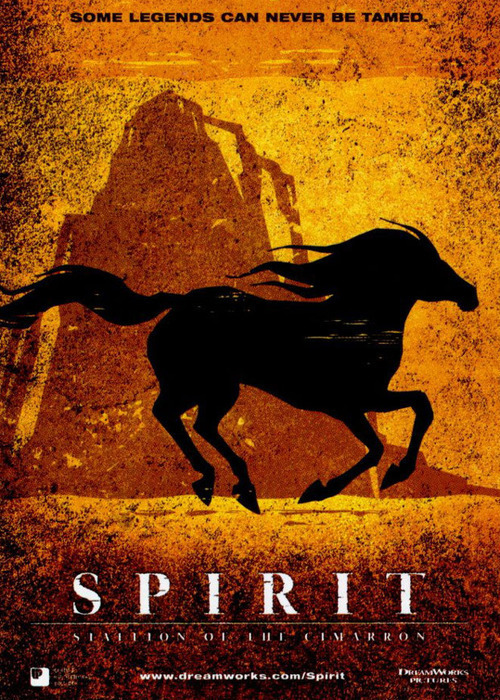 While I've been here, I've been trying to understand what sparked my interest in horses. I actually don't know the point it began, but I can name a few influences. I grew up in a town, and had little interaction with horses, but when I was around thirteen years old my family got a computer. On this computer was a film called "Spirit: Stallion of the Cimarron". This was one of the few films we had at home, so consequently I watched it a lot. I loved the film, and at one point I knew almost all the spoken words. It is a film about a wild mustang stallion who is captured by different humans (the cavalry and a Native American), and his struggle to be free. He is named 'Spirit Who Could Not Be Broken' by the Native American.
Around that same time I read Black Beauty by Anna Sewell. Thus the first few influential experiences with horses, even though they were fictional, were from the horse's point of view, and treated the horse as a thinking and valuable being. The combination of a free spirit and being bound in a herd is what has fascinated me when it comes to the horse. Also, I have always thought horses are beautiful animals, and as I enjoy art, I have seen them a lot in paintings. They are majestic animals, and there is power in a horse that attracts people.
From those early fictional experiences with horses, slowly my interest in horses grew. I sought out books and comics about horses (which were readily available and targeted at my age group and younger). I found books about horses in their wild state and became interested in natural horsemanship as introduced by Monty Roberts and Pat Parelli. I read books about this and became really interested in trying some of these methods out on a horse, but I didn't have access to a horse.
When I was 19, I decided to go to what in Norwegian is called folkehøgskole to learn natural horsemanship. This is a type of gap year school where you can go to learn something or spend time doing something you like. You could do anything from drama to skiing, natural horsemanship or gardening. I was lucky and found a school with a very good horse programme with few people and many horses. I learnt a lot about horses, and I was introduced to Stina and the Carolyn Resnick method by one of my fellow students.
That has led me to where I am today. Here, in this herd, there is a mare called Spirit. She is very sensitive and afraid of humans, and while I am here, she is one of my 'project' horses. That means I am spending time with her and getting lessons from Stina with her. I love it, but it is also a challenge for me, because when I am around horses that are afraid of me, I easily get afraid too. But she is a really sweet horse, and it is good to see that she functions very well in the herd. She is second in command, and is well respected by the younger mares. Jack, the only male in the herd, and Spirit have a close relationship. Whenever Darling, the leader, is not around, I often see Jack and Spirit hanging out together.
It is so nice to be able to see some of the friendly gestures of the horses, not only notice the bigger pecking order squabbles. I feel like I understand much more of how the herd functions and the language of the horses, just since I came here. This has come from a lot of observation when spending time with the horses in the first Waterhole Ritual, sharing territory. The horses give me more than I had ever expected. I understand the concept of real leadership - a leader who leads by example that you want to follow - much better now. The concept of teamwork has also become clearer to me, and I am constantly learning. I am very thankful for the journey I have had since those early introductions to horses. To think that a book and a film can have that big an impact on the direction my life has taken!
Books read: 20
Pages read: 5513
Tuesday, 5 April 2011
4. Rituals
Today was the first day of a clinic Stina is holding together with Farah DeJohnette. As a working student, I am an assistant at this clinic, so I get to participate in most of the programme (when I don't have to shovel poop or make tea). It is very interesting. Stina is a certified trainer of the Carolyn Resnick Method, which operates with something called the 'Waterhole Rituals'. This is essentiallly just a breaking down of how horses treat each other in a normal, wild herd.
Humans also have rituals. We have rituals for hygiene, for mornings, for evenings, for meals, and also for social life (in fact in most areas of life). For example we shake hands when we meet each other the first time, and we respect other people's personal space. Especially in cities, where lots of humans live very close to each other, we have lots of rituals (or norms) which we use and follow to feel safe. For example avoiding eye-contact with others while you're taking public transport, and staying at least one metre away from other people while shopping for groceries. Since humans naturally form and rely on habits, habits and rituals that are constant create a structured and reliable life and environment, and we feel safe when they are in place.
It is the same with horses. They are very social animals who live in herds, and have to function in a unit with others quite often. To make this work, there has to be a structure and a way of communicating that is universal for all horses (since horses change herds all the time in the wild). Carolyn Resnick studied wild horses and found the most important and covering rituals or set ways to interact that horses have and use actively.
The first two are quite intuitive: sharing territory and saying hello. I think I have mentioned this earlier, but these are very important basics when you deal with horses. Sharing territory is just being in the same space, and allowing the horse to come and go as it wants, while not paying much attention to the horse. Saying hello is analogous to the human ritual of shaking hands (except you do it quite often with the same horse). It involves holding your hand out to the horse (if the horse is close to you) with the back of your hand up. You then allow the horse to smell your hand or blow on it and then you go away. When two horses meet for the first time or are reunited, they blow in each other's noses, so this ritual is an imitation of that. You don't want to invade the horse's space for too long, therefore you move away afterwards.
I hope this wasn't too much horse talk for you, and if there is anything else (or more of the same) you would like to hear about, just leave a comment.
Books read: 17
Pages read: 4548
Humans also have rituals. We have rituals for hygiene, for mornings, for evenings, for meals, and also for social life (in fact in most areas of life). For example we shake hands when we meet each other the first time, and we respect other people's personal space. Especially in cities, where lots of humans live very close to each other, we have lots of rituals (or norms) which we use and follow to feel safe. For example avoiding eye-contact with others while you're taking public transport, and staying at least one metre away from other people while shopping for groceries. Since humans naturally form and rely on habits, habits and rituals that are constant create a structured and reliable life and environment, and we feel safe when they are in place.
It is the same with horses. They are very social animals who live in herds, and have to function in a unit with others quite often. To make this work, there has to be a structure and a way of communicating that is universal for all horses (since horses change herds all the time in the wild). Carolyn Resnick studied wild horses and found the most important and covering rituals or set ways to interact that horses have and use actively.
The first two are quite intuitive: sharing territory and saying hello. I think I have mentioned this earlier, but these are very important basics when you deal with horses. Sharing territory is just being in the same space, and allowing the horse to come and go as it wants, while not paying much attention to the horse. Saying hello is analogous to the human ritual of shaking hands (except you do it quite often with the same horse). It involves holding your hand out to the horse (if the horse is close to you) with the back of your hand up. You then allow the horse to smell your hand or blow on it and then you go away. When two horses meet for the first time or are reunited, they blow in each other's noses, so this ritual is an imitation of that. You don't want to invade the horse's space for too long, therefore you move away afterwards.
I hope this wasn't too much horse talk for you, and if there is anything else (or more of the same) you would like to hear about, just leave a comment.
Books read: 17
Pages read: 4548
Subscribe to:
Posts (Atom)